
Fiberglass Fabrics

Fibertex fiberglass fabrics are recognized for their versatility and strength, being used in various industrial applications. Produced with high technology, they are ideal for structural reinforcement, thermal insulation and protection in challenging environments.
Fibertex® fiberglass fabrics are structured in unidirectional, bidirectional and multiaxial forms with different weave patterns (designs), various weights and widths, allowing great flexibility of application while combining lightness, resistance to chemical deterioration, dimensional stability, dielectric properties and moisture resistance.
The weight in grams found in 1 m² of fabric is known as “grammage”. Fibertex® produces fabrics whose weights range from 50 g/m² to 1,500 g/m² and widths from 100 mm to 3,000 mm, the most common being 1,300 mm and 1,400 mm.
Weave Pattern
The weave pattern or design of fiberglass fabrics is how the yarns are arranged and interlaced in the fabric. The most common designs are: plain weave, twill, satin, Turkish satin, English satin, 8HS twill, these being unidirectional, bidirectional, biaxial, triaxial and quadriaxial.
The overlapping layers of fiberglass fabrics provide a final product without waviness. Laminate weight reduction can reach up to 25% by reducing fiber and resin, producing a laminate with higher glass content and lower resin content.
Bidirectional Fiberglass Fabric
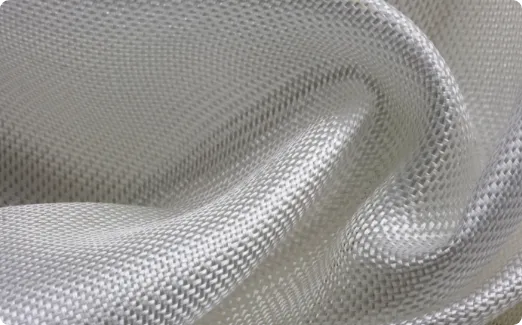
Fibertex® bidirectional fiberglass fabrics are easily recognized by their weave pattern. The weft (yarns arranged in the transverse direction) and the warp (yarns arranged in the longitudinal direction) are interlaced over each other, forming different patterns according to the design applied, at an angle of O° and 90°.
Manufactured with E-glass, Fibertex® bidirectional fiberglass fabrics provide greater resistance to delamination, flexural stress and tensile stress of the laminate. Fibertex® bidirectional fiberglass fabrics have their edges sewn and trimmed to prevent yarn loss or fraying. Their interlaced fibers provide a final product with high mechanical strength, reduced laminate weight and thickness, with higher glass content and lower resin content.
Advantages During Lamination
As a structured fabric, with side seams, trimmed edges tied with polyester yarns or very fine fiberglass yarns, it facilitates cutting and reduces fraying and waste, increasing the productivity of fabric cutting tables.
The combination of fabrics cut at various strength angles and different weights provides high laminate strength, increases productivity and makes lamination easier, reducing production time.
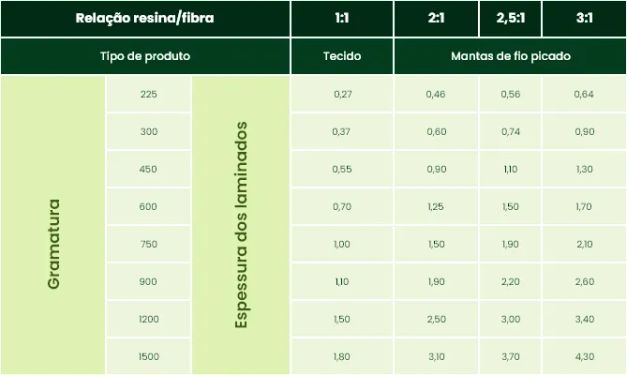
Thickness Variation Table of Woven Fabric/Mat Fiberglass Laminates (mm)
This table shows the variation of the resin/fiberglass ratio in laminates and the resulting thicknesses for the same weights, using resin of the same density. The characteristics of the mat and fabric used must be taken into account with regard to their resin absorption capacity, since each material reacts differently due to its own composition.
Unidirectional Fiberglass Fabrics
Typical Applications
- Plastic Reinforcement
- Sports Products
- Marine Products
- Structural Reinforcement
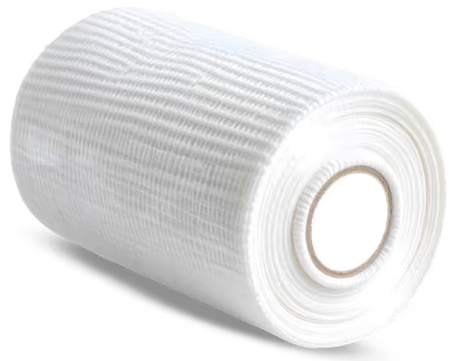
The unidirectional fiberglass fabric rolls are wound on cardboard cores (Tubetes) following the dimension criteria below and then wrapped in plastic film for subsequent packaging and identification. Fabric widths can be produced between 100 and 1,800 mm, with the most common widths being 1,300 mm and 1,400 mm.
Unidirectional fiberglass fabrics must be transported with proper tie-down and duly protected against the weather to avoid damage. Store in a dry, well-ventilated place, on wooden pallets.
This table shows the variation of the resin/fiberglass ratio in laminates and the resulting thicknesses for the same weights, using resin of the same density. The characteristics of the mat and fabric used must be taken into account with regard to their resin absorption capacity, since each material reacts differently due to its own composition.
Benefits and Differentiators:
- High mechanical strength.
- Versatility for structural and insulation applications.
- Lightweight and easy handling in various projects.
- Excellent performance in corrosive environments.
- Available in various configurations to meet different needs.