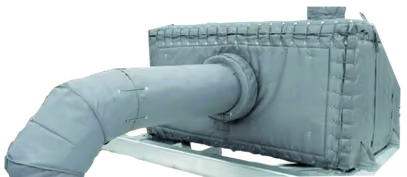
Removable Thermal Insulation for Machines

Fibertex removable jackets are versatile and efficient solutions for thermal insulation in industrial environments. Developed with high-strength materials, they provide safety, reduced heat loss and ease of maintenance.
Our purpose is to clearly and objectively inform users, engineers, applicators, students and everyone who deals with and encounters problems related to removable thermal insulation in the most diverse areas of our complex industrial sector.

Every industrial project aims to achieve results and extend the service life of installations and equipment by increasing performance and reducing operating costs; it is during the preparation of thermal insulation studies that we must pay attention.

At this precise moment, we seek to gather as many details as possible about the equipment to be insulated with Fibertex® removable thermal insulation, so that they are practical to remove and reinstall for possible maintenance and inspection of the equipment and piping.

Removable thermal insulation must be designed thermally to achieve maximum thermal efficiency, thereby reducing spending on energy fuels, since these represent a high cost; furthermore, insulated equipment / piping wears less and consequently extends its service life.

Fibertex® Removable Thermal Insulation also provides:

– Better working conditions for employees.
– Excellent handling for maintenance / inspection, thanks to the ease of removal and reinstallation of the pad or jacket.

Through this publication, we seek to disseminate the concept of modern Fibertex® removable thermal insulation.

Below is a comparative table of hot-face and cold-face temperatures after thermal insulation at various thicknesses.

Operating temperature (ºC)
350
350
350
350
Insulation used
Ceramic fiber 96 kg/m³
Insulation thickness (mm)
100
100
75
50
External protection used
Aluminum
Gray fabric
Gray fabric
Gray fabric
Emissivity
0.2
0.62
0.62
0.62
Cold face temperature (ºC)
50
43
48
58

Below, discover the types of fabrics used for thermal and acoustic insulation, as well as their respective operating, peak and softening temperatures.

Table of treated fabrics for manufacturing removable insulation

Product
Aramid Fiber Fabric
Aramid Fiber Fabric
Fiberglass Fabric
Fiberglass Fabric
Fiberglass Fabric
Fiberglass Fabric
Fiberglass Fabric
Fiberglass Fabric
Fiberglass Fabric
Ceramic fiber cloth FG
Ceramic fiber cloth SS
Silica Fabric
Treatment
Untreated
Bulked
Aluminum film
Aluminum foil
BR (acoustic)
Untreated
Rubberized
TC (acoustic)
Textured
Fiberglass reinforcement
Inconel reinforcement
Leached
Operating temperature
350ºC
380ºC
100ºC
150ºC
150ºC
400ºC
200ºC
150ºC
450ºC
600ºC
700ºC
700ºC
Peak temperature
400ºC
450ºC
130ºC
250ºC
200ºC
500ºC
250ºC
200ºC
550ºC
700ºC
800ºC
900ºC
Approximate softening point
NA
NA
870ºC
870ºC
870ºC
870ºC
870ºC
870ºC
870ºC
1200ºC
1200ºC
1704ºC

Benefits and Differentiators:

  • High efficiency in reducing heat loss.
  • Resistance to extreme temperatures and abrasion.
  • Reusable, making equipment installation and maintenance easier.
  • Customizable for different shapes and sizes.
  • Increased energy efficiency and reduced operating costs.

Download the complete catalog

Check the technical specifications

Markets Served

Sugar and Ethanol

Learn more

Glass Industry

Learn more

Chemical and Food Industry

Learn more

Oil and Gas

Learn more

Steel and Metal Foundries

Learn more
Contact us to get a customized proposal for your industry.